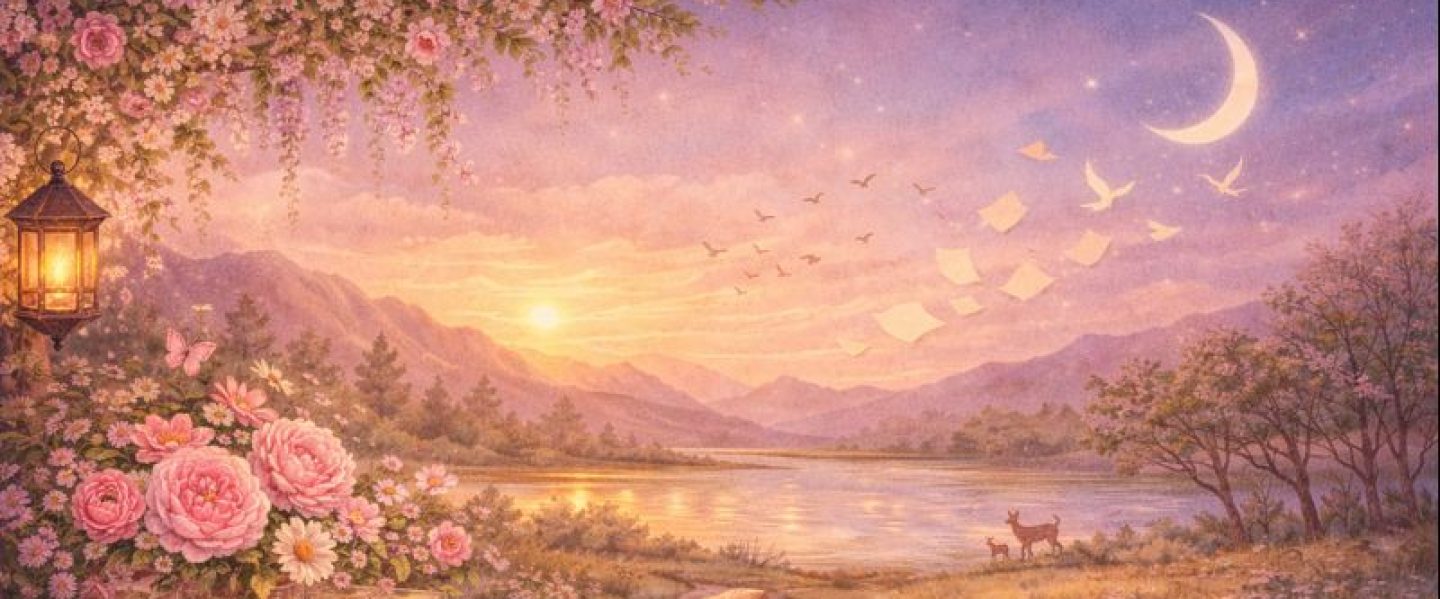
I gaze at the open meadow… and I hear the voices of children as they run through the poppy fields with arms outstretched to catch the butterflies.
There’s a little girl playing dress-up in a backyard. She is a world-famous actress. Giving a speech to her captivated audience, she pauses to take a breath and revels in the feeling of such adulation.
An awkward teenager is going out on her first date; daring to kiss a boy, she wonders if he will ask her out again. Fearing that her parents might detect the blush on her face… she lingers outside till he has gone away.
A young woman is setting off on an uncertain course in hopes of discovering her purpose in life. She still sees the face of the young man she was so smitten with… but they were forced to part ways, on that fateful day. In her heart, she harbors a wish their paths might cross again… but destiny often makes other plans than the one we would choose for ourselves.
A mother to be is filled with the anticipation of her child soon to be born… It isn’t long before he takes his first steps and on the first day of school, she reluctantly turns to go… knowing that she must relinguish a part of him, as he grows.
A child becomes a caregiver to a beloved parent; every day, draws nearer to the time when they must part. Taking her hand in hers, she whispers, “I love you,” before she is gone from this earth.
Now, an aging grandmother, looking at her grandchildren and seeing her life in retrospect, I hug them with a sense of urgency that life demands… as if for the last time.
The ghosts of the past merge with the present, and somethings change while others remain constant. Life is transient, fleeting; we have little time… and I, too, will become only memories to those whom I leave behind. Let me grasp the moment in… daylight before the solitude of night.
iHeart Radio: The Poetry and Prose of Lora Hollings
Cherish The Day
Cherish the days, the moments spent with loved ones, the beauty that is around you, and memories that brought you joy and wisdom.
Time is Like A River
Continuum
What is this Beautiful Music called Continuum?
What is the Continuum?
To me, it tells a story about our ancestors who came before us carving out a life in a new land and living in harmony with nature so that they could bring forth more life into their new world… sharing their joy, the new knowledge that they acquired, and their love. This continuum is a sacred gift that we’ve been given to go forth in our lives and acquire new knowledge and insight illuminating the path of those who will come after us… so that with each new generation, greater knowledge and wisdom will bring forth a better life and world for those generations who come after us.
The repetition of the chords played by a combination of wind and string instruments represents the continuation of generations as a constant while the voice of the violin represents change and progress; change as we acquire more knowledge which leads to new discoveries and ways of thinking. Hopefully, we will continue to move forward embracing a higher ethic in our treatment of others.
We are the proud descendants from those who loved freedom to the point that they were willing to fight for it and give their lives for it. A nation who is proud to be made up of immigrants who also bravely fought for the cause of freedom and whose wonderful contribution to our diverse culture cannot be denied. Our strength as a Nation is built on our Democratic principles of governing with fairness and equality. “With Malice Toward None, With Charity For All.” We cannot become oblivious to the important lessons we acquired from history if we are to remain a Democracy and stand strong in what we value most and the legacy that we will pass on to future generations.
Insight from this poem
Ghosts from the Past is a reflective meditation on the passage of time and the unfolding stages of a woman’s life. Through vivid moments of childhood innocence, youthful longing, love, loss, motherhood, and aging, the poem reveals how memory shapes identity and deepens emotional awareness. Each scene captures universal experiences — dreams of greatness, first love, separation, personal discovery, and the tender responsibilities of family — reminding the reader that life moves forward even as the past remains present within us.
The poem emphasizes the fleeting nature of existence and the inevitability of change, yet it also highlights enduring constants such as love, connection, and human vulnerability. As generations shift and roles reverse, the speaker recognizes the urgency of cherishing each moment. Ultimately, the poem invites readers to embrace life fully, honor memories, and live consciously in the present before time transforms us into memories ourselves.
I hope that you enjoy the following poem, “The Cowgirl Poet.” It is about a lady who has a more intellectual nature attracted to someone who is quite different than herself in this respect and so remains aloof from him. But by the end of the poem, she realizes that they are alike in spirit for she has just as strong a desire to be free and independent as he and thus the name, “The Cowgirl Poet.”
The Cowgirl Poet
Oh, Mr. dad-blamed I want none of your profane- Me, a Midwestern gal, who’s used to much tamer places and unwithered faces; not a man whose hands are as rough as his way with words… No red lipped fluesy am I… that hangs out in saloons and waits for some guy.
Why, I went to finishing school and have dreams up there in the starry sky… moonlit nights with my mind in rhapsodic trance with verse… that is where my passion lies.
A poet is who I long to be… whose works are judged profound, and mentioned with such company… as Bishop, Cather and Pound.
Not in wearing a plunging neckline with painted lips, to attract Mr. buckaroo boy.
Away, on the open plain into the clouds, he rides and one can hear the sound of hooves as they meet the ground… and soon he is out of sight.
Give me the hustling, bustling pace of the city so I can lose myself… into another place of existence. Yes, Mr. Urbane who enchants me with his sophistication and worldly wisdom, who has tried many professions and has a different vision.
I can’t defer to buckaroo boys who drink and kiss hard. It is the life of the intellect- fervid romance with the softness of words… that I prefer, and the sweet little mementos on my desk from one who has been brought up in a manner that speaks of gentility and tranquility.
Not destined to become the lady of a cowboy knight riding on his bronco under a bold moon… alone in his world.
Yet there is a part of me, sympathetic to a desire to be so free- away from the crowds and the city lights, and instead of the din of a siren howling… a coyote’s faint cry which can be heard in the still… desert night.
Maybe we are alike- you and I, a longing to roam this earth and be free of constraints… to feel the breadth and depth of life before it is gone.
Yes, you and me, dancing under a silvery moon, to the strains of an old cowboy’s tune before we finally… part.
Mama’s Don’t Let Your Babies Grow Up to Be Cowboys
This song sung by Waylon Jennings depicts the spirit of the Cowboy and his compelling need to be free. In that respect, cowboys remind of poets who also have a strong desire to be free to think and write their thoughts and sometimes lead an unconventional lifestyle.
“Don’t Fence Me In” sung by Roy Rogers is all about the cowboy or cowgirl spirt.
Roy Rogers sings… “DON’T FENCE ME IN” in “Hollywood Canteen” with TRIGGER
I think that we all identify at times with the American cowboy and his freedom to ride away on his horse and live in a closer relationship with nature. The cowboy is uniquely American and is a kind of symbol for America and what it stands for- to be free to follow your heart and dreams. Maybe that’s why we like to watch TV shows and movies about them. The following is the beginning and ending of the famous Roy Rogers show which was very popular in the fifties and which always closed with Roy and Dale’s great duet theme song, “Happy Trails.”
Roy Rogers,Dale Evans And Sons Of Pioneers – Medley Greatest Hits(Classic Songs from the West)
Symphonic Works Depicting the Cowboy Spirit
Aaron Copeland was an American composer, composition teacher, writer, and later a conductor of his own and other American music. Much of his music is typical of what many people consider to be the sound of American music with its slow changing harmonies evoking the vast American landscape and its spirit. His works include the Appalachian Spring Suite, and the ballets: Billy the Kid and Rodeo. When you listen to these compositions, they create images of the American landscape with its vast openness, beauty, and the cowboy spirit.
Billy the Kid by Aaron Copland
Rodeo by Aaron Copland
Appalachian Spring Suite by Aaron Copland
Insight from this poem
The Cowgirl Poet explores the tension between two powerful human longings — the desire for refinement and intellectual identity, and the deep call of untamed freedom. The speaker initially distances herself from the rugged cowboy world, rejecting what she perceives as its roughness in favor of education, sophistication, and the cultured life of poetry and thought. She seeks recognition among literary greats and imagines a future shaped by intellect rather than raw experience.
Yet beneath this resistance lies a quiet fascination. The cowboy’s independence, connection to nature, and boundless freedom awaken something within her. The vast desert, moonlit skies, and haunting cry of the coyote symbolize a life unrestrained by societal expectations. What begins as contrast slowly transforms into recognition — the poet and the cowboy share a common yearning to fully experience life.
The poem ultimately reveals that refinement and wildness are not opposites but complementary aspects of the human spirit. Through imagery of moonlight, open plains, and gentle reflection, the work suggests that true fulfillment comes from embracing both intellect and instinct, structure and freedom. The Cowgirl Poet becomes a meditation on identity, choice, and the universal longing to live authentically before life passes.
Throughout the ages, horses have been used by mankind in his battles, for ploughing fields, mining coal and transporting goods and people in rural areas and in fast growing cities. Horses have played a vital role in our history, and they are loved by many as affectionate and loyal companions.
The following poem is about a woman and her feelings for her most faithful friend, her horse, and her thoughts about losing him someday.
My Noble Steed
Throughout time I have traveled with you, my noble steed, across the Kingdom of the Pharaohs, you have traversed the land with lightning speed…
in all terrains and adversity to fight the battles with men, to witness firsthand the wages of war and mankind’s inhumanity…
to whatever fate you have resigned— only to ask that when you die, we will be there at your side.
I see a gallant soul in your eyes…
With the pulse of your stride, through forest and field, I feel each beat of your heart and ask that we shall never part.
If this world should come to an end, I only ask that you be with me, my valiant friend…
and if destiny should decree that you go before I, emblazoned in the sky,
so shall I see you with wings as you fly, as your ancestor, winged Pegasus.
In the depth of my soul, with each and every breath, I pray that you will be with me after death.
Narrated by the horse himself, this beloved classic shines a light on the cruelties that animals suffer at the hands of humans. It is full of simple moral lessons and takes the reader from the beauty of a spring country evening to the hard working life of Victorian London. It offers a fascinating, detailed portrait of Victorian English life and a meaningful reminder of the simple truth that animals have feelings.
Black Beauty was the only novel by Anna Sewell and and the first major animal story in children’s literature. The author wrote it “to induce kindness, sympathy, and an understanding treatment of horses”; it was published in 1877, shortly before Sewell’s death.
Confined to her house as an invalid, Sewell spent the last seven or eight years of her life writing Black Beauty. The book, a fictional autobiography of a gentle highbred horse, had a strong moral purpose and is said to have been instrumental in abolishing the cruel practice of using the checkrein.
I highly recommend this book for both children and adults not only because it is a great story but for its profound message too.
Movies Based on The Riveting Story of Black Beauty
From The Beloved Classic Comes An Inspiring New Vision
Insights
For the Love of Horses reflects the profound emotional and spiritual bond between humans and horses, portraying these majestic animals as loyal companions, symbols of strength, and sources of deep inspiration. The work emphasizes the timeless partnership between horse and rider, highlighting how horses have accompanied humanity through history in war, labor, exploration, and personal connection. Beyond their physical power, the poem explores the horse’s noble spirit, sensitivity, and intuitive connection to human emotion.
The reference to Pegasus introduces a mythological dimension, elevating the horse from earthly companion to a symbol of transcendence, freedom, and eternal presence. This imagery suggests that the bond between human and animal extends beyond physical existence, touching the realms of memory, spirituality, and enduring devotion. The poem conveys reverence for the horse’s loyalty and expresses a longing for unity that continues even beyond life itself.
Ultimately, the work serves as a meditation on companionship, trust, and unconditional connection. It reminds readers that relationships with animals can provide emotional grounding, inspiration, and meaning. Through themes of love, loyalty, and transcendence, the piece celebrates the horse not merely as an animal, but as a noble partner in life’s journey.
“Throughout history, the greatest crimes have happened to innocent, sentient beings hidden from others’ view.”
The Grim Truth Behind The Dolphin Smile
When we see dolphins perform for us at places like Sea World or Dolphin Resort, many people think that it is wonderful and the dolphins are happy because their curved mouths give the appearance that their smiling all of the time but it’s really the dophins’ natural expression.
Are the dolphins really happy living in captivity? And how did the dolphins get to the marine park or dolphinarium in the first place? The dolphins that we are the most familiar with are the bottle nosed dolphins as they are typically the ones that we see perform for us at marine parks. They live in the temperate and tropical waters of the Pacific and Atlantic Oceans and every sea that has this kind of water. So how did they end up here? Most people have never heard of the dolphin trade and that for the few dolphins that we see perform at a marine park, there is a great sacrifice of thousands trapped in a cove, caught in nets, and unable to escape a horrific fate.
It is Dolphin Captivity that Drives the Dolphin Hunts
Hidden from the eyes of the public for decades, an unsightly, bloody, and most violent event takes place every year in the Cove as pods of dolphins are slaughtered there and the water turns to blood red.
This is how the annual hunt begins…
Every year on the fifth of September marks the opening of the dolphin hunting season in in Taiji Japan. During the six-month season, thousands of dolphins are corralled into narrow coves and a few are captured for sale to aquariums or amusement parks but those that aren’t selected by trainers for aquariums or amusement parks to perform before the public are brutally killed for meat.
After the annual dolphin hunt was covertly filmed for a documentary, the little fishing village of Taiji, Japan suddenly found itself in the uncomfortable center of a media spotlight.
Police and fishermen as a rule in Taiji don’t allow filming of the hunt going on in this village, shrouded in secrecy even from those that live there. The area is sealed off by a barbwire fence and signs which read “Keep Out.” But a team of courageous activists and filmmakers risked being arrested and went undercover to shoot the footage of these dolphins being killed and telling their riveting story in the 2009 documentary, “The Cove.”
Since its release, the documentary — which won the Audience Award at the Sundance Film Festival and the Academy Award for best film documentary — has spurred an international outcry against the capture of these intelligent and sensitive mammals for the purpose of killing for meat. In one case, Taiji’s sister city — Broome in Western Australia — suspended its relationship with Taiji for as long as dolphins continue to be killed. And yet the killing still continues today…in the cove.
The Cove Documentary
“In a sleepy lagoon off the coast of Japan lies a shocking secret that a few desperate men will stop at nothing to keep hidden from the world. In Taiji, Japan, former dolphin trainer Ric O’Barry has come to set things right after a long search for redemption. In the 1960s, it was O’Barry who captured and trained the 5 dolphins who played the title character in the international television sensation “Flipper.” One fateful day, a heartbroken O’ Barry came to realize that these deeply sensitive, highly intelligent and self-aware creatures must never be subjected to human captivity again. This mission has brought him to Taiji, a town that appears to be devoted to the wonders and mysteries of the sleek, playful dolphins and whales that swim off their coast. But in a remote, glistening cove, surrounded by barbed wire and “Keep Out” signs, lies a dark reality. It is here, under cover of night, that the fishermen of Taiji, driven by a multi-billion dollar dolphin entertainment industry and an underhanded market for mercury-tainted dolphin meat, engage in an unseen hunt. The nature of what they do is so chilling and the consequences are so dangerous to human health that they will go to great lengths to halt anyone from seeing it.”
The Cove Movie Trailer
A Poem About The Truth Behind Dolphin Captivity
The Blood Dolphins
Trapped in the cove, the dolphins wait. Some will go to a marine park to amuse the spectators there… with their amazing agility and beguiling smile, the people eagerly applaud.
But truth lies hidden behind the dolphin’s smile in a very different reality; feeling the anguish of a captive, he cries in his heart for freedom.
Behind this scene, a spectacle contrived for our pleasure, is a grimmer one– a truly horrible spectacle indeed that has been kept secret in the cove.
Blessed with intelligence and charm, he has been turned into a pawn to enrich the pockets of some while others do him great harm… such an innocent creature who has no idea about human greed… and the depths of depravity.
Surfers and sailors have all reported his nature to befriend mankind- coming to his aid against shark or pushing him ashore when he almost drowned. Have they not heard of his noble deeds?
But these dark figures, they wait to kill the dolphins who still remain captured in the cove… bloodthirsty and senseless to any appeal to their humanity.
What defense has he against the minds of such men… with prejudice making them impervious to see- these sensitive, intelligent creatures for what they truly be?
Filled with irony, in a play worthy of Sophocles, the dolphin who was once worshiped as a god in Ancient Greece for his virtue and vitality… would now become the subject of a Greek tragedy– victimized by those who are blinded by their own human conceit.
With a last thrust of his spear, the poor dolphin continues to thrash in pain and struggles to flee; his cries for help are drowned out by the louder ones… to hurt and to kill.
The fisherman has blood on his hands and death in his soul. He is as cold as the dolphin… inside, that he has so willingly sacrificed.
For he has allowed himself to be a killing machine, doing the sordid work for others without question, blinded to the truth you see… how dangerous is he.
Yes, he is as cold as the dolphin… inside, for his soul died after he killed just one; but it has gone on so many times, he has lost count.
So many times, he has thrust that spear that not even the sight of so many dolphins writhing in such torment, and so much blood can move him as he is dead too, you… see.
Ric O’Barry Talks about His Days as A Trainer for Flipper
Taiji is the largest supplier of dolphins to marine parks and swim with dolphin programs around the world. Each dolphin sold for these commercial ventures sells for more than $150,000.
It’s the captivity industry which keeps the slaughter going by rewarding the fishermen for their bad behavior- driving the dolphins into the cove and capturing them. The people that are involved with capturing these dolphins can get more than $150,000 for a live show dolphin but only $600 for a dead dolphin. The dolphins that aren’t selected by the trainers for marine parks are trapped in the cove and killed for meat.
The trainers sent to Taiji from these marine parks are looking for “Flipper,” says O’Barry. But as O’Barry recounts his days as a trainer for this very popular program, he talks about Kathy, one of the dolphins used for this television series.Tragically he revisits the moments of her death which forever changed his views on dolphin captivity and the tragedy of keeping these intelligent, self-aware, and very sociable animals in captivity.
In the following interview he talks about Kathy making a conscious decision to hold her breath and die. In this context says O’Barry, “Kathy committed suicide.” Dolphins and other Cetaceans (members of the whale family) aren’t automatic breathers like we are. They have conscious control over their breathing. They can choose to end their life when life becomes too unbearable by just simply refusing to breathe.
When Ric O’Barry started out as a dolphin trainer, there were only three dolphinariums. Now it is a multibillion dollar industry.
Discourse With Ric O’Barry
What’s Wrong With Dolphin Captivity?
Dolphins are beautiful captivating creatures of the ocean. These glorious animals are friendly, loving and energetic. In the wild dolphins travel in pods with their families. We admire these animals because of their ability to communicate and show love towards humans, yet capturing them to become performers is a sad life for a dolphin and can destroy them.
There are many risks involved when dolphins spend their lives in captivity. They have a much shorter life span than dolphins in the wild. Many who are captured only live for a few years and some don’t even survive the capture. More health problems are associated with dolphins that live in captivity due to chlorine poisoning. This can also lead to blindness from chemical exposure, and ulcers. Many dolphins in captivity are also more susceptible to pneumonia, and some of them experience stress related disorders and even shock.
Dolphins in captivity are confined to a limited amount of space that can cause them to become frustrated and bang their heads against the tanks. Captive dolphins can quickly become bored and flustered so they will swim around in circles, sometimes in panic and distress. It can be traumatic for young dolphins to be separated from their mothers and other family members. Dolphins in the wild love to swim for miles each day, and when they are captured to live in captivity their freedom is stripped from them because they are limited to a small amount of space. Some captive dolphins due to high stress levels will act out aggressively by biting some of the other dolphins they are forced to live with in captivity.
Watch Amazing Dolphins In The Wild
The Best Place to Watch Dolphins is in the Wild
The best way to see dolphins is in the wild where they belong- not in an artificial, cramped aquarium where they don’t have the opportunity to really be dolphins and live the life they were intended to have. To deprive any animal of its natural behaviors- the ability to engage in a wide variety of behaviors- by putting them in a tank or aquarium is to deny these dolphins a life with their family groups and what gives them joy- freedom! In the oceans, dolphins swim up to 40 miles a day. Dolphins are extremely intelligent, social and self-aware animals; putting them in captivity for the sake of our entertainment is really wrong and selfish of us.
I hope that someday soon that our humanity will finally help us to realize that wild animals weren’t put here for our entertainment or amusement, any more than we were put here to be enslaved for the entertainment of others. When we think about using wild animals for our entertainment, we must use empathy or the ability to share and understand the feelings of others. How would we feel if some other species were able to capture us, taking us away from our family, and put us in a physically restricted, artificial environment where every day we would have to perform for them, and never be able to be free to live the life we loved!
Watch dolphins in their natural environment- in the ocean where they belong-not in a dolphinarium or marine reserve. This is like prison for a dolphin just like it would be for us to constantly live in a confined space without our freedom and nature’s compelling call to live according to our own instincts- living only to be at the beck and call of others. Isn’t dolphin and whale captivity a form of slavery?
Slaughtered Dolphins and Toxic Meat
Each year thousands of dolphins are slaughtered in a small town called Taiji on the west coast of Japan (mostly unknown to the majority of Japanese public). The meat is fed to the community despite being so heavily contaminated with mercury, almost toxic waste! The Japanese government has yet to recognize the scientifically proven health risks of eating dolphin meat.
How Can We Put an End to Dolphin Slaughter
25,000 dolphins and porpoises are killed in Japan every year! How can we help put an end to this cruel, senseless killing?
It is dolphin captivity which drives the annual dolphin slaughter in Taiji, Japan. If people would stop buying tickets to watch dolphins perform at marine parks and to swim with them in dolphin pools we would stop the demand for dolphins and end the dolphin slaughters!
Ric O’Barry talks about what YOU can do against dolphin slaughter
Insights
Blood Dolphins: The Cruelty of Dolphin Captivity offers a powerful social and environmental commentary that challenges the illusion of happiness often associated with performing dolphins. The work exposes the hidden violence behind marine entertainment industries, revealing how captivity drives large-scale dolphin hunts and the suffering of highly intelligent and self-aware animals. Through both factual discussion and poetic imagery, the piece highlights the emotional, physical, and psychological trauma dolphins endure when separated from their families and confined to artificial environments.
The poem The Blood Dolphins intensifies this message by portraying dolphins as innocent beings betrayed by human greed and exploitation. The contrast between their natural compassion toward humans and the brutality they face underscores the moral contradiction at the heart of captivity. The work also explores broader themes of freedom, empathy, and ethical responsibility, encouraging readers to reconsider humanity’s relationship with nature.
Ultimately, the piece serves as a call to awareness and action, urging society to reject entertainment that depends on animal suffering. It emphasizes that true appreciation of wildlife lies in protecting animals within their natural environments, where they can live freely according to their instincts and social bonds.