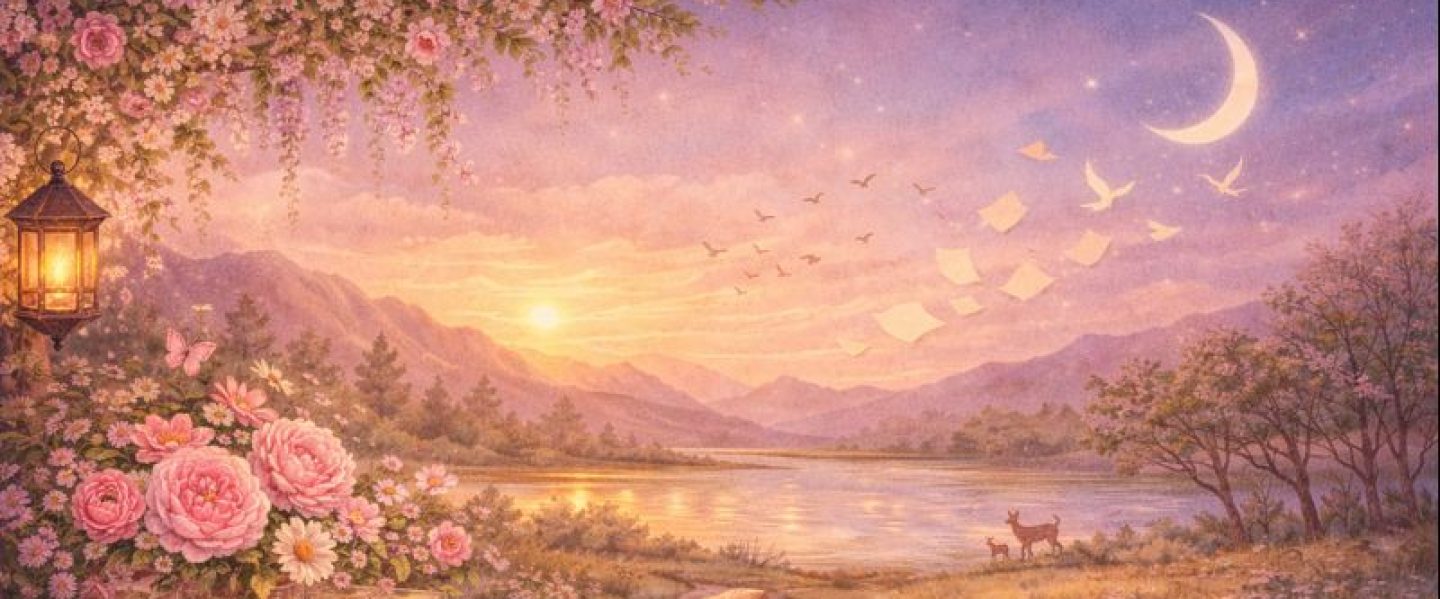

Oh Lovely Ladybug
This poem is an invitation — the speaker asks the ladybug to take her somewhere. Not to a real place on a map, but to a world of bluebells and cowslips, rainbows bridging earth and sky, tea with the ladybug queen who has never been seen. It is one of the most purely imaginative poems in the series, built entirely from longing and wonder.
What the speaker wants is not grand or complicated: to be light as a feather, to dance on flower tops, to take flight. To escape for a moment into a world where beauty is total and nothing is heavy. Every child has felt this impulse. Lora Hollings gives it words.
The Poem
Oh Lovely Ladybug
Oh lovely ladybug,
take me to a land so fair
where I do not have a care…
In a meadow where
a rainbow bridges earth and sky,
and hills that reach high —
where there are bluebells and
cowslips everywhere.
In a dress like yours
that is red with black spots,
let me dance on flower tops…
And sip tea
in a lovely lea
with the ladybug queen
who has never been seen.
Let me be light
as a feather
and give me wings
so I can take flight —
to a land of ladybugs
filled with such delight.
Before You Read — Ask This
🌟 Wondering Questions
- If a magical creature offered to take you somewhere wonderful, where would you ask to go?
- What does it feel like to be “light as a feather”? When have you felt that way?
- What is a lea? (Hint: it rhymes with tea.) How would it feel to sit there?
- The poem says the ladybug queen “has never been seen.” Why is something unseen sometimes more wonderful than something real?
Word Treasure Box
Small, bell-shaped blue wildflowers that bloom in spring, often carpeting woodland floors in vivid blue. One of England’s most beloved wildflowers.
Delicate yellow wildflowers that grow in meadows, with a gentle sweet scent. Their name comes from an old word meaning “cow dung,” but they smell heavenly.
An old poetic word for a meadow or open grassy area. Often used in older poetry for its sound — soft, open, unhurried.
A simile meaning weightless, effortless — as if nothing is heavy or difficult. The speaker wants to be free of all weight, literal and emotional.
To fly, to lift off and soar. But it also means to escape — to leave the ordinary world behind and go somewhere else entirely.
The ladybug queen is a figure of pure imagination — mysterious because she is invisible. The unseen is often more powerful than the seen in poetry.
Flashcard Study Set
Nine cards exploring the poem’s vocabulary, imagery, and the world of longing it conjures. Click any card to flip it.
After You Read — Talk About It
If a ladybug could take you to a magical land, what would it look like? What would be there that the real world doesn’t have?
The speaker wants to dress like the ladybug. Have you ever wanted to dress like something in nature? What would you choose?
The ladybug queen has never been seen. Why might something we’ve never seen be more magical than something we have? Can you think of other examples?
The speaker wants to feel light as a feather. What makes you feel heavy sometimes? What makes the heaviness lift?
The land she longs for is a place where she “does not have a care.” What would that feel like? When have you felt it — even briefly?
The speaker asks for wings. If you could have wings for one day, where would you go and what would you see?
Real Wonders — The Science
🍃 Did You Know?
- Bluebells and cowslips are real meadow wildflowers. Both are native to Europe and bloom in spring. Bluebell woods are one of the most celebrated natural sights in England.
- Ladybugs really do dance on flowers. They move in short, exploratory bursts across plant surfaces, feeding on aphids and pollen. Their movement on flower tops really does look like dancing.
- Rainbows really do bridge earth and sky. A rainbow is an arc of refracted sunlight — always at a 42-degree angle from the anti-solar point. You can never reach the end. That’s part of the magic.
- Ladybug wings are hidden and beautiful. Beneath their spotted shells are delicate translucent wings — folded origami-style. When unfolded, they are nearly twice the length of the body.
Create & Explore
✨ Activities to Try
- Draw Your Ladybug Land: Illustrate the world the speaker imagines — the rainbow, the bluebells and cowslips, the flower tops, the invisible queen’s tea table. Make it as magical as you can.
- Write a verse: Add your own stanza to the poem. What else would you ask the ladybug to show you in this magical land?
- Bluebell or Cowslip Study: Look up images of bluebells and cowslips. Draw them. What time of year do they bloom? Where do they grow?
- Design Your Ladybug Dress: If you could dress like a ladybug, what would your version look like? Design it — what colours, what details, what accessories?
Reading Guide
| Element | What to Notice |
|---|---|
| Address | Like “Ladybug, Oh Where Are You?,” this poem speaks directly to the ladybug — “take me,” “let me,” “give me.” The requests pile up, each more heartfelt than the last. |
| Sensory richness | The poem builds a world through colour (red, black, rainbow), plants (bluebells, cowslips), movement (dance, flight), and feeling (light as a feather). All senses are invited. |
| The invisible queen | The ladybug queen “who has never been seen” is the poem’s most haunting detail. Ask: why does Lora Hollings make her invisible? What does unseen add? |
| Central Message | Imagination and longing for beauty are not childish — they are a deep, valid human need. The desire to take flight is not escapism; it is the spirit reaching toward what it loves. |
- List the wishes: Count all the things the speaker asks for or wishes for. How many are there? What do they have in common?
- Find the colours: What colours appear in the poem? Map them. How does the colour palette contribute to the world the poem creates?
- The invisible queen again: Compare this queen with the Ladybug Queen from her own poem. They seem to be different beings. How are they similar? How are they different?
- Yearning poem: This poem is entirely about wanting something — a whole world made of longing. Write your own poem that is entirely a wish list: “Take me where…, let me…, give me…”